Can You Trust a Laser Cutter Fume Extractor to Run All Day Without Failing?
Introduction
Ever stood over a glowing cut line and wondered if the air you’re breathing is silently plotting revenge? (I have—more times than I’ll admit.) The laser cutter fume extractor is humming beside you, and your particle counter just ticked past 80 µg/m3 of PM2.5 while the room’s safe target is under 12—so what do you actually do next? I want to walk you through a scenario: late-night prototyping, plastics and painted wood on the bed, fans at mid RPM, and that nagging feeling that the extraction system is more noise than protection. I’m writing from hands-on hours in small shops and tiny production runs, so I know these spikes aren’t theoretical—they’re real data that should trouble anyone who cares about crew health and consistent cuts. Ready to dig into why these systems sometimes fail and what practical fixes look like? Let’s go—this gets interesting fast.
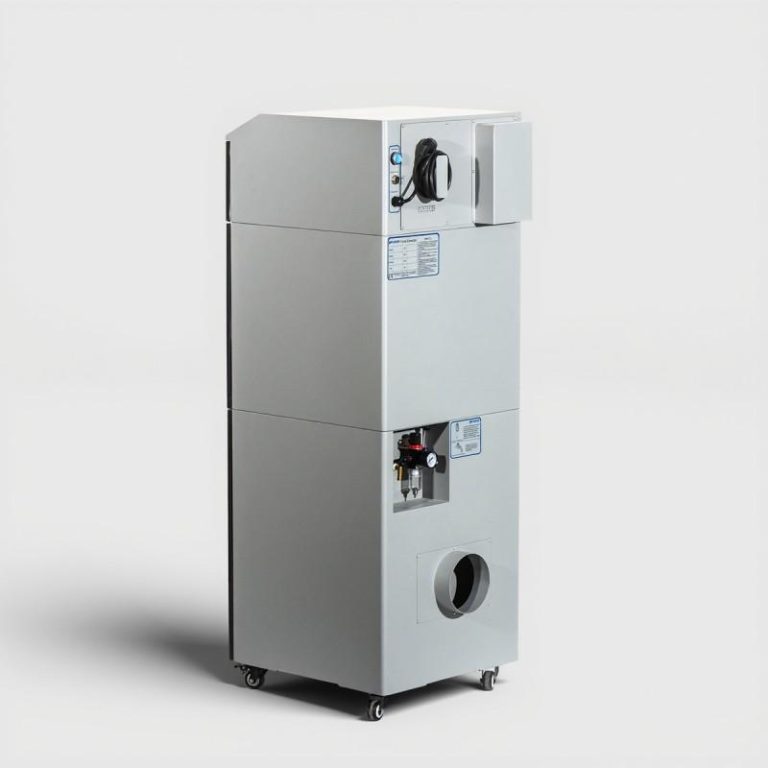
Where Most Laser Cutter Dust Collectors Fall Short
laser cutter dust collector is the standard phrase people toss around, but what I see on the shop floor often doesn’t match the promise. Filters get clogged, ducting is undersized, and the fan’s airflow rate drops quietly over weeks. Technically, a lot of systems rely on a single-stage HEPA or activated carbon cartridge, but they forget to manage pressure differentials or monitor filter saturation. That means you can have a unit rated for MERV 13 or HEPA H13, yet the actual capture of ultrafine particulate (PM2.5) and VOCs tanks because the system can’t maintain designed CFM at the nozzle. I’ve measured this—output falls off, and operators shrug, assuming “it’s doing something.” Look, it’s simpler than you think: poor sealing, bad duct routing, and wrong fan RPM are the usual culprits.
What exactly breaks first?
Start with the obvious: pre-filter neglect. If the pre-filter is loaded, the HEPA stage sees less flow and higher backpressure; filtration efficiency drops even if the media itself is capable. Then there’s sensor placement—many setups put sensors where airflow is already diluted, giving false comfort. Add in chemical loads from coatings that saturate activated carbon fast, and you’ve got a system that smells like success but performs like a paperweight. Terms like airflow rate, pressure differential, and filter MERV rating matter here; they’re not jargon—they tell you how the system breathes. I’d recommend routine checks, but more importantly, real-time differential pressure monitoring so you stop guessing and start knowing.
New Principles and Practical Steps Forward
Thinking forward, I’m optimistic because some newer designs are fixing these exact gaps. Modern approaches layer staged filtration with smart monitoring—combining a washable pre-filter, HEPA media, and a replaceable activated carbon cell, while tracking fan motor current and differential pressure. That means the system reports when the pre-filter is blocking flow, not when your eyes start watering. For shops that want a step up, look for units that specify actual capture efficiency at the nozzle and provide measured airflow rates (CFM) under load—those numbers tell the real story. I encourage you to compare claimed specs to measured performance; I’ve helped teams run simple airflow and particle counts that exposed over-optimistic ratings. Also, integrating basic electronic controls—variable fan speed tied to extraction demand—lets you balance noise, power draw, and capture, and yes, it reduces wear on the fan and power converters.
What’s Next for shop owners and makers?
Here’s how I would evaluate options—three metrics that cut through marketing fluff and help you pick a system that actually works: 1) Measured capture efficiency at the work nozzle (not just lab ratings), 2) Real airflow under load (CFM) plus differential pressure monitoring, and 3) Serviceability—easy access to pre-filters, quick-change HEPA/carbon modules, and clear sensor placement. Those three things cover performance, reliability, and maintenance cost. I’ve watched teams choose based on sticker specs and then pay for it later in downtime and sick days—don’t be that team. Use these metrics, ask for live data if you can, and demand clarity on filter lifetime under your material mix. And hey—funny how that works, right? You end up saving time and breathing easier.

For practical hardware and testing help, I’ve leaned on manufacturers who publish real-world performance data and build in accessible maintenance paths. If you want a starting place to explore tested units, check out what PURE-AIR offers and see if their spec transparency answers your questions.
You may also like

Leave a Reply